Vision

To help transition Japan to a peace promoting post-carbon country while enjoying every step of the process.
僕のビジョンは、祖国日本で、平和文化を育みポストカーボン(Post-Carbon) 社会を促進してゆく事です。
化石燃料や原子力に頼らず、他国の資源を取らない、
自給自足な国へのトランジションを実現させてゆきたいです。

Showing posts with label Tools and Technology 道具とテクノロジー. Show all posts

Friday, May 10, 2013

5.11-12.2013 藤野トランジションの学校【藤野電力】Fujino Transition School 2: Fujino Electric

日本語は下

Transition Town Fujino started a program called Fujion Transition School. I've been attending as a staff, researcher, and activist. Its a really awesome project and well designed. Transition Town Fujio has done some amazing things and is an inspiring example of how Transition Towns can be. This weekend they will showcase Fujion Electric. They have done lots of solar system making workshops, solarizing an old school, and setting up electric bikes with a solar charging station in the town. Currently they have plans to make a community owned small hydro plant to relieve themselves of dependence to TEPCO (owners and promoters of the Fukushima nuke plant). 

Fujino is a really cool town even without Transition TOwn, I recommend checking it out. They have satoyama, lots of art and artists, daily alternative events, and a generally chill vibe. The event includes tasty conscious food, onsen (hotspring) and night time party.


スタッフとしていくよ〜
おすすめ!
内容を考えるととてもお得。


ーーーーーーー☆☆ーーーーーーーーーー
「藤野トランジションの学校」のご案内
「持続可能な地域、どうつくる?」
ーーーーーーー☆☆ーーーーーーーーーー
持続可能なまちづくりを市民が自らの創造力を駆使しながら進めていく
イギリス生まれの市民運動、トランジション・タウン。
循環する未来へどう転換していけばいいのか、いまどきのコミュニティ
づくりのコツを、藤野の自然のなかで、いっしょに動きながら考えましょう!


第2回目になります、藤野トランジションの学校。
今回は『藤野電力』編!
藤野電力がなぜ、こんなに注目されたのか?!
(私たちにもわからないのですが)その全貌を公開します。
藤野電力のメンバーが集結して、活動の楽しさや活動のしかた、運営のしかた、
その世界観をお話する時間を設けます。
ぜひ、ご参加ください!!

(2)5月11日(土)・12日(日)《地域でつくるみんなのエネルギー》藤野電力
・藤野電力のご紹介
・ミニ太陽光発電WS(@牧郷ラボ)
・組み立てた太陽光発電で、『シェーナウの想い』上映会
・藤野電力の「秘密」対談
・アートビレッジ発電所見学+解説

【スケジュール】
(1)4月13日(土)・14日(日)《トランジション・タウン》トランジション藤野
(2)5月11日(土)・12日(日)《地域でつくるみんなのエネルギー》藤野電力

(3)6月8日(土)・9日(日) 《森の再生への道筋を探る》森部
(4)7月13日(土)・14日(日)《自給自足のつながりを作ろう》お百姓クラブ
(5)9月14日(土)・15日(日)《超高齢社会をどう支える?》健康と医療
(6)10月12日(土)・13日(日)《自分たちの価値を見直そう》地域通貨よろづや
(7)11月9日(土)・10日(日)《新しいつながりが生まれる》コミュニケーション

<詳細>
●会場:藤野倶楽部 無形の家 神奈川県相模原市緑区名倉3743-1●時間:1日目午前10:00~ 2日目午後4:00
●参加費: 1回12,000円。3回以上のご参加の場合は11,000円です。
地域通貨よろづ割引できます。1回11,000円+1,000萬。
上記の金額に含まれるもの・・・会場費・2日間の食費(2日目の朝食を除く)・
温泉代
上記の金額に含まれないもの・・・宿泊費・2日目の朝食代
●宿泊 別途1日4,000円で古民家の宿泊(+朝食代)が可能です。
●定員:20名(先着順)
●お申込:
http://kokucheese.com/event/index/75312/

からお申し込み頂くか、
以下のメールに氏名・住所・メールアドレス・電話番号(携帯をお持ちの方は携
帯の番号も)
・参加を希望される回・宿泊の有無をご連絡ください。
ttfujino@gmail.com


藤 野 電 力 と は

2011年3月11日の震災、そして福島の事故を機に、
今まで当たり前として世の中にあった様々な常識がほころびつつあります。
安全安心に毎日を暮らしていくには、
エネルギーも今までの中央集権型から、
住民が自ら参加出来るような自立分散型へ移行していきたい。
そしてエネルギー消費自体を少なくしつつも、
我慢ではなく、より新しく、より楽しく生きていけるような、
暮らし方へと移行していきたい。
藤野電力とは、自然や里山の資源を見直し、
自立分散型の自然エネルギーを地域で取り組む活動です。
そして目指すものは、エネルギーシステムの移行自体より、
むしろそれによってもたらされる、地域の豊かな未来なのです。


Tuesday, October 16, 2012

Ecovillage Saihate (Kumamoto) 三角エコビレッジサイハテ(熊本県)


(日本語で)Rainbow Aso 2012の続き。。。

Continuation from the previous blog, Rainbow Aso 2012.


今回のレインボー阿蘇に招いてくれたのが、
三角エコビレッジサイハテ。
フェスが終わってから紹介してもらった。
モバイルカフェとともに阿蘇から三角へ!

The group that invited me to speak at the festival is called Ecovillage Saihate. I got to go for a short visit after the festival. Transported along the narrow roads of rural Japan with the mobile cafe.


エコビレッジサイハテは山の上にあって
海に浮かぶ島々を眺めている。
柑橘系の果樹園が放置状態で、
みかんは食べ放題。
柿はカラスに食われていた。

DJとVJが立ち上げたエコビレッジの住民は
パーミー(パーマカルチャー実践者)や
タイル職人、台湾からの
グラフィックデザインナーなどが住んでた。

This is a fresh new ecovillage started up by a DJ and a VJ (Video Jocky). There are premies, a tile designer, a graphic designer, musicians, fun loving people living in the village at the moment. The property includes a citrus grove that is currently unmanaged but it was abundant with fruit, and the crows were hitting the non-astringent persimmons. 

色々面白いイベントを企画しているみたいで、
野菜が入場料のギブミーベジタブルって
いうイベントに最初は誘われていた。
皆が持ってきた野菜で
シェフが晩ご飯をつくったらしい。

The do a lot of creative events/parties here. Originally, I was invited to an event called "Give me vegetable", where attendees were asked to bring veggies as the entrance fee, and a chef cooked up the harvest for dinner. It was an event that attempted to bring old-school local farmers together with the groovy transplant artists.

施設はとっても充実していて、
様々なDIYプロジェクトに役立つ
道具がそろっている。
壊れた道具を分解して、
部品の再利用もしている。
そこにいれば何でも作れそうな感じ。

土地を買った時について来た物もあれば、
住民やビジターが持ってきた道具などがある。

The have an impressive collection of facilities and tools, much of which came with the property. Many unfinished projects lying around mainly because everybody was busy preparing for the Rainbow Aso festival which this ecovillage played a central role.


溶接機と未完成の家具
Welding machine and unfinished furniture


陶芸スタジオとジャンベ
Pottery studio and a jimbei
Beat inspired pottery


本格的な木工作業場
Woodworking studio


レコーディングスタジオ
Recording studio


ころがっていた未完成のロケットストーブ
いずれは美しいモザイクで飾られる。
An unfinished rocket stove,
soon to be covered with a beautiful mosaic.


大広間にはロケットストーブベンチがある。
上が畳になっていて和風感が漂う。
Trippy looking rocket stove tatami bench.


大きなスペースにはターンテーブルや
ドラムセット、大きなスピーカーがスタンバイ中。
The main hall is ready for a party anytime.
Two turn tables, drumset, and big speakers.


建物はミッキーのアートで飾られている。
Mikey's art decorates the structures.
She is a graphic designer visiting from Taiwan.


たまり場(カフェ?)の外には
The hangout spot/cafe


アースバッグのコンポストトイレと
アースオーブンが完成間近。
Work in progress earthbag compost toilet and cob oven


糞が畑に流れるように工夫された鶏小屋
The chicken coop designed so that the feces/nutrients washes into the garden

自由でDIYな感じが魅力的だった。
みんなで楽しみながら新しい生き方を
創作しようとしている感じ。

ビジョンは
「衣食住をみなおし、文化的循環型コミュニティーを創る」

It was a really nice place full of DIY culture.
Their vision is to become self-sufficient and develop a sustainable culture.


出発前は愉快な仲間と昼食。
左側がやたら盛り上がってる。

Final meal with the ecovillage residents.
I recommend a visit if you want to check out new-style Japanese alternative living.

おすすめスポットだよ。
東京の活動がなければ長期滞在したかった。

ホームページもcheck it out.
Their homepage:

Friday, January 6, 2012

Blog Blog Blog. A bloggers reflections.

I never thought I'd become a blogger. Especially after going through a rapid process of simplifying my life because of activism-burnout that I experienced in 2006. My email box is still full of over 1000 unopened emails during my UC Santa Cruz organizing days. Its overwhelming to even think about looking through those.

But, what started out as an experiment to explore new technology and poke fun at my primitive self, has now become a regular practice in my daily life. It has been an amazing tool to organise my thoughts, stay connected with friends (since I don't facebook), distribute "valuable" information, and network with people. All without the stress of external deadlines, quality standards, and costs.

This blog started as a way to learn about blogging through posting pictures and my notes from life at the Bullocks Permaculture Homestead. One of my main goals has been to provide more info about permaculture in Japanese. But, I also wanted to spread the love to my non-Japanese readers, as I believe the knowledge and experience at the Bullocks is an invaluable resource for creating a sustainable world.

Now, the blog is a bit of a mess, but a good representation of my cluttery active mind.
I believe the main topics are:

  • Permaculture, natural farming and sustainable living
  • Activism
  • Mindfulness and Engaged Buddhism
  • Nukes
  • War and Peace
  • Systems sciences
  • Consumer culture and cultural change
Its all related.


Realizing that I still have a lot to learn about blogging, and that this blog was getting a little chaotic, I decided to start new blogs for new projects. Now I have a total of four blogs and I'm cautiously considering another. Here is the critical question, is the blog a tool that I benefit from, or is the tool now controlling my life?

I chose not to own a car, a cell phone (until I moved to Tokyo a couple months ago), a facebook account, etc. because they seemed to be controlling how people around me lived. People talked of how they couldn't imagine life without these tools. But, my life has been great without owning those things. And now that I have a cell phone, I can't quite say if my life is better or worse. It's convenient in some ways, and inconvenient in other ways. But I  know I can live without it, and be happy.

I spend a lot of time blogging. And thinking about blogging.
For now, it seems like a good way to use my time and energy,
especially now that I live in the hyper-urban tragedy known as Tokyo.

But, I'm not sure how I would feel if the internet went down,
and if I could no longer access my blog, email, and all the virtual info that I depend on.
Losing access to a "free" internet could happen, and perhaps not too long from now.


This blog, like many others, started out with a thought that I would write a quick article and list my blogs, and here I am 40+ minutes later still typing. Believe it or not, some articles take several hours.

Da Otha Blogz


1. Tokyo Urban Permaculture
This is basically a website for my Tokyo regeneration project. It's primarily in Japanese, but I just added a English page, other pages, and pictures. Initially I was going to try a word.press website but it looked like a little more work than I was prepared to do.

2. Occupy Kasumigaseki Japan
I wanted to create a bilingual site to do outreach for the occupy kasumigaseki movement. It was also an opportunity to explore a new tool, tumblr. I was hoping to get more people involved but it hasn't happened yet. Like blogger, tumblr is really easy to use but quite a different format.

3. Eco Resources Library
I haven't mentioned this blog yet, but it exists. It's a personal data storage site. Sort of like bookmarks, but with more visual info.  I just come across an overwhelming amount of cool info and I've been having a hard time keeping track. Some of these resources stay in my inbox and add to the 1700 unopened emails, some become another unapplealing bookmark, and others disappear back into the info abyss. So, I decided to create a virtual data base to organize them quickly and not have to worry about them anymore. That way other people can also benefit. Its a diverse mix of great websites and associated ideas and resources. Many come from the only blog I got tricked into following:
http://makewealthhistory.org/  It's really well done, much better than anything I do.

Tuesday, November 9, 2010

Pedal Powered Grinder Mill ペダルパワー製粉機

Hi everybody. I have left the Bullocks homestead for the winter and have been doing an action packed journey South toward Santa Cruz, CA. Right now I'm at my friend's home at the Frey's Biodynamic Vineyard in Redwood Valley. It is an amazing place and I am always impressed by their aesthetics, practices, and musical community. On my way down, I also had the chance to do a bike tour of CityRepair projects in Portland, plant a food forest at Hood River Middle school, and see magnificent redwood trees (my favorite) in Humboldt County. Huuuuuuuuuge!!!!

To get me back on track, I'll start with a simple article on the topic of appropriate technology.

This is a pedal powered grinder mill that I saw/experienced when we visited some friends on the other side of Orcas Island. They found the pedal parts at the Exchange and joined it to the mill. Simple and effective design for home grinding.
島の反対側に住んでいる友達の家で見たペダルパワーの製粉機です。自転車の部分はゴミ処理場から救出した部品で作られたそうです。それを手動の製粉機と合体させた、とても単純で使いやすいテクノロジーでした。
Here is the grinder in action. We are grinding wheat berries for fresh bread, yeah.
製粉機を使っている様子です。パンのために麦を挽いています。やっぱりパン好きならこうこなくっちゃ。

BONUS
This is the hot tub they have on the property. Its basically a large barrel that could probably squeeze 5 people, and is heated by a snorkel wood stove. Again simple design.
同じ所にある薪風呂。5人つめられる樽の中に暖炉が入っている単純なデザインです。

Basically just a metal box (marine-grade aluminum) inside the tub with a lid and chimney. These are manufactured but with some welding experience you could make your own. Here is the website for the product. http://snorkel.com/ 

I remember images of oil drum bathtubs that probably were somewhat common in rural Japan. Just get a 55 gallon oil drum, cut the top open, put a wooden floor to stand on, then elevate the drum (eg with cinder blocks or bricks) in order to have a fire pit directly below it. I think the tricky part is that this system seems to depend on another person tending the fire and keeping it at an optimal temperature. Here is a link for those images via GOOGLE

Tuesday, September 21, 2010

Chinampa II  チナンパ(第二)

*See entry below this one for an introduction to chinampas
チナンパ入門の方は「チナンパ」エントリーも見てみてください。

A young chinampa with a visible foundation of branches and twigs. Like a floating cold compost pile.
比較的新しいチナンパ。チナンパの土台となる枝などがむき出しです。水の上に浮いている炭素中心のコンポストみたいですね。
Interns and a guest moving a pile of brush across the marsh from a chinampa island. Brush piles like these become the foundation of chinampas here. As Dave was explaining to me the other day, many of us toil in the soil to increase organic matter. It is fairly common practice to then burn that organic matter (like branches and leaves) or more recently to send it to industrial composting operations instituted by the city. Building chinampas is a way to not only utilize this valuable resource (aka waste) but to also increase biologically productive land. Its also a fun activity that stimulates our mind's sense of wonder.


These are pictures from the chinampa peninsula that extends from Doug and Maria's garden. An example of how the early stage of a chinampa looks like. A coarse fabric of brush with willow plantings and volunteers (aka "weeds") along the edge. This one still feels like a trampoline and the entire chinampa seems to bounce up and down if you get into it.

ダグとマリアさんのガーデンから沼に突き出るチナンパの写真です。これもまた若いチナンパで、絡み合った枝の周囲に柳やボランティア(雑草)が生えています。このチナンパはトランポリンみたいで、頑張ればチナンパ全体が上下に沈んだり浮いたりします。

A mature chinampa peninsula with willow established on the edge for land stabilization.

熟したチナンパの半島。柳がワイルドに育っています。

This is the chinampa that we all entered the marsh from to work on one of the chinampa islands during the PDC. A solid chinampa peninsula with a fire pit and canoe landing at the tip. This peninsula, unless you were told, would be hard to tell that it was permy-made. The edges of this well-established chinampa are lined with an oak, paw paw, hazelnut, edible fruiting hawthorn, basketry willow, polygonum (giant knotweed), aronia, timber henon bamboo (left side of the picture), pear grafted on quince rootstock, highbush cranberry and a few others.

Here is a side-view of the fire-pit chinampa. You can see the Henon bamboo to the right. On the left side of the chinampa you might be able to spot the highbush cranberry and pear on quince.

This chinampa has a wikiup built out of cattails, a replication of what the native peoples' built for a quick dwelling in this region. 100% compostable.
原住民が一時的な宿を必要とした時に作っていた「ウィキアップ」のあるチナンパ。これは、ある研修生が沼のガマで作ったものです。ゴミを出さない、土から生まれ、土に帰る宿。
A bunch of permies crammed into the wikiup during a tour. I remember last year a course participant decided to setup camp inside. An important consideration about thatch roofs and structures such as these, is that they are slowly composting above you. They are also great habitat for insects, mice, rats, etc. Frequent fires inside for heating or cooking will help preserve the natural material and keep creatures away.

Doug mentioned to me that this chinampa is 28 years old.....I think its the oldest one that the Bullocks initiated here. It has a cool structure that hovers above the marsh. The picture above is after we cleared most of the willow along the peninsula recently, and below is a more beautiful presentation of this picturesque setup taken in the summer.
Another thing Dave mentioned to me about Chinampas is that when resources become more seriously limited, for instance if we cannot find a replacement for the solar pump that is essential, and the pumps are no longer functioning, chinampas will become a more essential element for food production here as they are subirrigated. He painted a picture of a series of peninsulas and islands with canals inbetween, much like how the Aztecs did it.

Its also quite beautiful to have a system that is not dependent on plastic pipes, complex materials, and electricity. If you have a site appropriate for chinampa, try it out! Call your friends and have a chinampero party! Orale!

Thursday, September 2, 2010

The Energy Tour

Energy. So much of life is about energy.........from electricity, fossil fuels, heat, food, hybrid, to vibrations, Qi, exercise, ecstasy, good health, etc. Its one of those things that we use a lot of without really knowing what it is, where it comes from, and what happens to it.

What is energy for you?
How do you engage with "energy"?
When you design for energy, what are key considerations?

I like the approach taken by my Tai Chi teacher in England. As we flow through the movements he questioned us, "what can we do less of?" We would explore how we can use less energy to do the same moves. Similarly in tea ceremony practice, the movements are about beauty and efficiency with as little waste as possible. Then there is aikido where I learned about how to redirect violent energy toward a constructive compassionate direction. I think these are important lessons for me, as I bring awareness of my daily movements and how I design my physical environment.

Below are some pictures and simple explanations from the energy tour that Doug and Sam Bullock ran during the PDC. I did not include our solar showers and various PV systems in this entry. Enjoy:)

The energy tour started with our beloved solar (boom) cart. I think this was a previous Pc (permaculture) Design Course project to give participants a basic understanding of the home solar electrical system. Free energy is captured on the solar panels and flows through a charge controller, volts/amps meter, a car-battery that runs a car stereo and speakers. All you need to do is plug your mp3 player or computer and bump that music.

We use the boom cart when we work in the gardens, in the kitchen, in the Aloha lodge for dance parties and movie nights. We are hoping to make a smaller and lighter version.....what else can we stack onto a solar boom cart? Maybe a mini fridge with beers and ice-cream? Switch that into a tea-water boiler for the winter. And some moving laser lights for late-nite dance parties.

Next on the tour is the solar dehydrator made of an old fridge painted black with a home-made solar heat collector. Air is sucked into the solar heat collector through vents on the bottom, then heated in a box painted black with a sealed glass lid. The hot air continues to rise to the bottom of the fridge unit and moves up until it exits through the chimney. It is essential to have the solar heat collector to be lower than the dehydrator in this type of design. There is a lot of resources online for you.

Our greenhouse is an excellent space for examples of energy use. Heat is an essential element in a green house and winter is the challenge/design opportunity in the Pacific North West. The gravel on the floor of the greenhouse acts as thermal mass that will absorb heat when the sun is out and radiate heat as the greenhouse cools. For the winter, we move our kitchen back into the greenhouse, so we are able to generate heat from our bodies, propane stove, and on-demand water heater for the sink. The sauna annexed to the greenhouse and the rocket stove water heater Doug is standing next to (for heating shower water), both release quite a bit of heat into the greenhouse. We are also making dehydrator racks for the sauna, so in the Fall when we have abundance of produce and much desire for the sauna, we can sauna then with the excess heat dry food.

The rocket stove above consists of two cylinders with water between (aka water jacket). The black color helps to heat water when the sun is out too. The silver object to the top left of the rocket stove is a hot water tank (with silver bubble wrap insulation). Its critical to locate the hot water tank above the rocket stove for the thermosiphon to work effectively.

Here is a brief description of rocket stoves,
"a rocket stove achieves efficient combustion of the fuel at a high temperature by ensuring that there is a good air draft into the fire, controlled use of fuel, complete combustion of volatiles, and efficient use of the resultant heat. It has been used for cooking purposes in many third-world locales (notably Rwandan refugee camps) as well as for space and water heating." (wikipedia) See below for a cob rocket stove for cooking.


Here is a demonstration of a thermosiphon, "a method of passive heat exchange based on natural convection which circulates liquid without the necessity of a mechanical pump." (wikipedia). The sun heats the water inside the black pipe (not covered by the tarp) that then flows into the top of the water tank as cool water exits the bottom of the water tank and travels down the slope to heat and recirculate. This is the mechanism for our 3 passive solar heated showers, rocket stove water heater, and solar dehydrator.

Think about how much these simple systems can save you on energy bills, and more importantly our consumption of fossil fuels that keep us dependent on some of the worst human rights abusing democracy-subverting organizations of the world.....energy corporations. Particularly the 6 oil supermajors: ExxonMobil (US), Royal Dutch Shell (Netherlands/UK), BP (UK), Chevron Corp.(US), Total SA (France), ConocoPhillips (US).

Large-scale energy independence is not only an essential step to restoring our life support system (the ecosystem), it would also be a great leap for building true democracy in a political system that continues to be manipulated by financially and politically wealthy corporations.

Yeah, thermosiphoning passive solar water heaters for democracy!
.......anybody?

One of the books that heavily influenced my perspective and direction in life is "The Party's Over: Oil, War, and the Fate of Industrial Societies" by Richard Heinberg. He writes very simply but with extensive research on extremely pertinent issues related to energy and ecology. From understanding the basics of what energy is, what electricity is, what the laws of thermodynamics are and why they matter in our everyday life, to how our energy use and production has evolved through human history. I really enjoyed his brief exploration of Western history looking at the rise and fall of empires through the lens of energy. He also does a sobering examination of alternative energies in context of our modern society and industry attempts to maintain control through centralized systems. It makes so much sense that by consuming less energy we would solve so many problems that plague us today, but then again consuming substantially less in a consumer culture is a big leap for many.

Energy independence is a revolutionary act.

Here's a demo of how much electricity this set of PV panels are producing. There are several sets of PV systems on the homestead that either keep our water pumps going or run our electricity demanding appliances, power tools, and charge batteries . I might go more in depth of the PV systems later but my understanding right now is quite basic.

For anybody wanting a project to learn about PV systems, you might start with an all DC solar music unit.

BONUS: a few more energy related technologies we use.

Cob rocket stove made from clay harvested from the site. Cob is basically a mix of clay, sand, straw, and water. We have 2 rockets stoves, a pizza/bread oven, and a bath shell made of cob on-site. Rocket stoves are easy to make, materials are cheap or free, you can use small-diameter fuel (e.g. twigs and wood scraps), and it produces efficient concentrated heat. There are lots of variations of this and its up to your imagination what you can do. For example, http://small-scale.net/yearofmud/2009/04/27/building-a-rocket-stove-part-2-cob-bed-and-bench/

The hay (Yeah!) box. This is an amazing technology that can be easily made. Its basically an insulated box that utilizes the heat of the food that is being cooked to continue the cooking process. Like grains and beans. Just bring to a boil and throw it in the box overnight and if you did it right, you will have hot cooked food by morning. We also make yogurt in the hay box.

This one looks like a plywood shell, a cardboard inner box, with random pieces of wool stuffed in between. The lid (top left) is heavy and is probably insulated in a similar fashion. We stuff an old wool sweater around the pot or yogurt jars and put a cotton cushion on top before closing the lid. The more insulation the longer the heat will be retained. As an added bonus, pressure cookers can also save energy by cooking food much faster.

More about energy in the future. On a final note for today, it is important to be aware of embodied energy, the energy consumed to produce, transport the product, and the energy costs to retire them. Basically accounting for energy needed for the entire life cycle of a product.

E=MC2

Saturday, July 3, 2010

Kitchen Greywater System

お皿や手を洗った後のお水をどう再利用できるでしょうか?
生活排水はどういう事に向いている資源でしょうか?
また、現在の一般の人が理解できない複雑でエネルギー消費の高い中央形下水システムを、どうもっと持続可能なシステムに工夫できるでしょうか?

(読み続ける前に、ちょっと考えてみてください)

How can we utilize water from our sinks after washing dishes and hands?
How can we save energy from our complicated water systems that send our used water to faraway facilities that clean it then send it back to us?

最近作ったアウトドアキッチンの生活排水システムです。来週から始まる3週間のデザインコースへ向けての準備の一つ。コースに参加する31人と外から来る様々な先生方8〜10人に、普段からここで生活している研修生の生活排水を効果的に利用するのが一つの目的でした。お水は生命にとって非常に貴重な資源なのです。
ーー続くーー

Recently, we spent a few days upgrading our outdoor kitchen greywater system. For a while the water from our kitchen sinks were soaking a slope of herbs and flowers in that area. The new and improved system has a much larger capacity, and can be directed to water different plantings.

The beginning (kitchen sink)
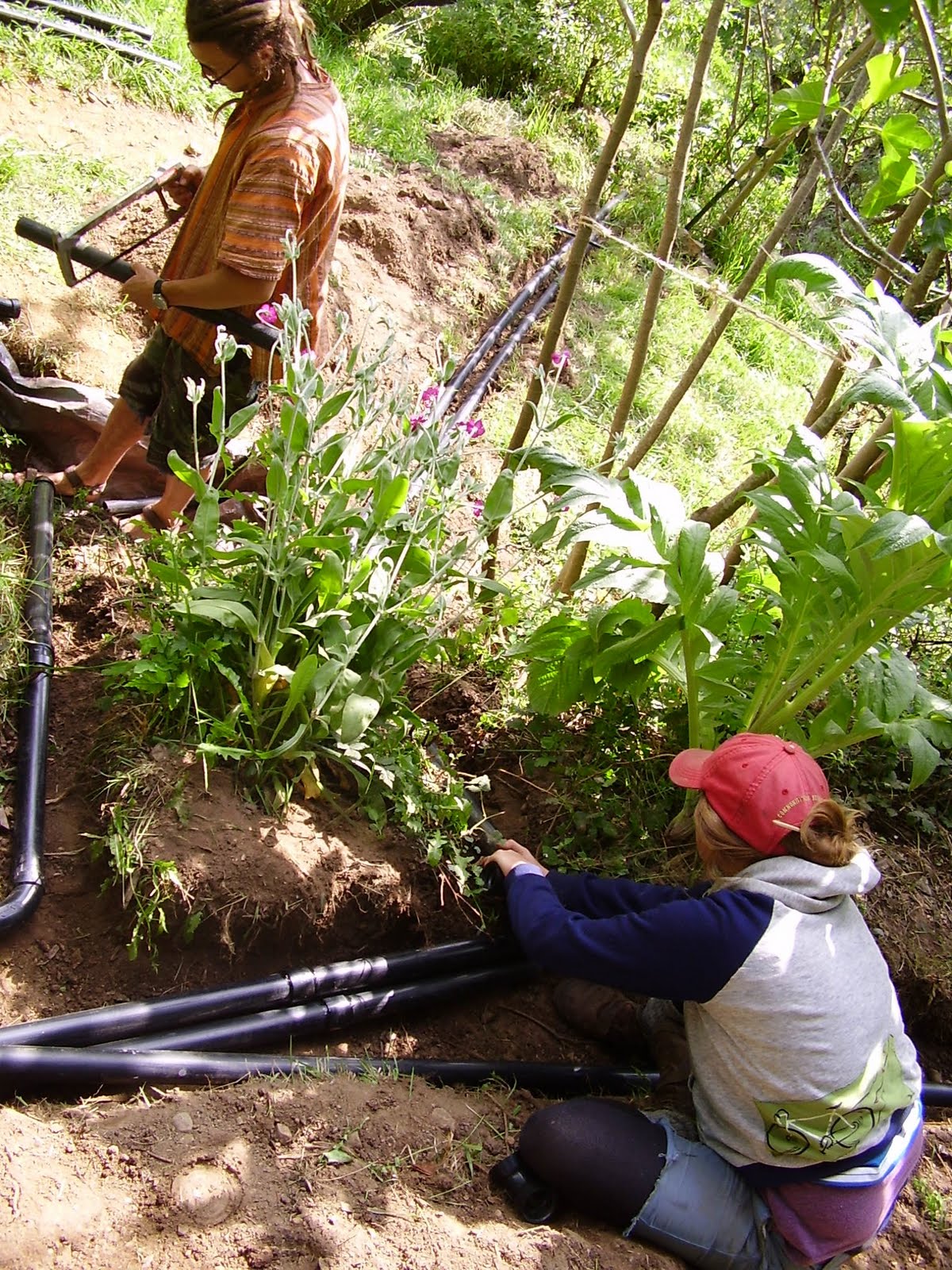
The kitchen sink drains into one of 4 pipes. Depending on where we want to water, we can manually switch the pipe/area. Super simple design so anybody can figure out what is going on.


We dug a bunch of trenches to install a series of ABS pipes (black) that transport the water via gravity to a series of mulch basins (holes filled with coarse woodchips) in between perennial plantings. You can see the kitchen sink at the top in the picture above. The three pipes on the top slope lead to 3 different areas each with a few mulch basins.

Interns cutting, placing, and assembling pipes.

The flow splitters need to be level in order to have equal distribution of water to the two downhill pipes. Sand and/or gravel are helpful for leveling things, just like building a foundation. A hole was drilled at the top of the splitter then corked. This way if food gets stuck in the splitter, we can easily unclog it. Flow splitters are a specialty part that you can get from Oasis Design http://oasisdesign.net/catalog/index.htm#flowsplitters

Tatton deep in thought.
How is this pipe a metaphor for life?

This is the end of the pipe. The water drops out of the pipe onto the mulch. A shield keeps rodents from getting to little pieces of food that flow out. Having the pipe higher than the mulch prevents clogging of the pipe. A stone cap is put on as a rodent barrier and to make it look nice.

Before burying the pipes, we check the water flow rate with a jar and stopwatch to make final adjustments. This part of the system split the water into 4 mulch basins. We timed how long a mason jar would fill up at each outlet and adjusted the pipes as needed. I think there were two outlets that filled the jar in 7 seconds and one that filled in about 13 seconds. That's almost twice as much volume per second. Always good to check your system, before covering it.


Caitlin's notes on the kitchen gray water system.

SUMMARY: Basically, pipes from the sink lead to downhill holes filled with stuff where the water flows into and seeps into the soil. The flow of the water from the sink -> filter (plastic colander with straw in it, cheap and simple) -> pipe -> splitter -> pipe -> flows onto mulch.

This way greywater is transformed from waste into a resource. And we save a lot of energy, which is at at the heart of much of our problems......and solutions. Fossil fuels, nuclear, etc. What we implemented here makes sense for our site, and each site will have different opportunities and challenges. This won't work in non-percolating soils as is. But with permaculture lenses a effective solution can be found.

A few final notes on the beauty of this system. Anybody can implement this system (few simple parts), uses no energy once setup (lots of work to dig trenches and making plastic requires energy), easy for people to understand the system which is great for teaching, fixing, and expanding, and its cheap. Plus it fulfills a need (watering perennial plantings) with a waste product (greywater). There are other things I could add but I need to sleep.

* We use biodegradable (liquid soaps and detergent). In alkaline soils you'll need sodium free soap.

RESOURCES
Architect Friedensreich Regentag Dunkelbunt Hundertwasser's tree tenants are pretty inspirational for urban settings. Art Ludwig (Oasis Design) authored a few essential books on designing greywater systems, and Brad Lancaster's Rainwater Harvesting for Drylands. I also remember attending a talk by two girls who were the Gray Water Guerrillas. They were doing good work, check them out at http://greywateraction.org/content/about-us. Related topics/systems are black water systems and rainwater harvesting but I will get to that later. As always, there are tons of information on the internet.

ONE LAST NOTE......
in Costa Rica and Nicaragua, most rural homes that I saw had a short pipe from the sink that stuck right out of the wall, where the water would fall into a shallow ditch dug into the dirt, that lead to a patch of banana plants. Now that is a simple system! And, the bananas thrive on that greywater. I'll keep an eye out for a picture.