To help transition Japan to a peace promoting post-carbon country while enjoying every step of the process. 僕のビジョンは、祖国日本で、平和文化を育みポストカーボン(Post-Carbon) 社会を促進してゆく事です。 化石燃料や原子力に頼らず、他国の資源を取らない、自給自足な国へのトランジションを実現させてゆきたいです。
I had the opportunity to visit Australia at the beginning of this year. I was on my way to Tahiti to teach on Peace Boat (NGO in Japan that does educational cruises and anti-nuclear and peace work). I did a few workshops in my usual donation-without-obligation style, and was rewarded with this lovely video.
Thanks so much to Cecilia Macaulay for organizing the workshops (I appreciated how much you stretched to be an organizer!), and Friendly Farms production for making this video. Hope to visit Australia again!!! Maybe at the end of 2018 or 2019.
Here is more on the gift economy and how I hold it → GIFTivim
We’ve been working on designing and redesigning (its always dynamic) the human ecology of the Dojo project and Tokyo Urban Permaculture, so the physical progress has been limited as planned. The social permaculture aspect of this project is really quite fascinating, and that is my particular interest, but I won’t get into that right now.
We are now working on the earthen walls tsuchikabe. We’re also trying to figure out where to put showers and the grey water system, and I’m super slowly working on another compost toilet.
Below is a bilingual video of our first tsuchikabe workshop facilitated by Kyle who is super awesome and thorough. My explanation on the other hand is not perfect/accurate, but I think you’ll get the gist of it. My aim is to get 60% of what I say right!
Also, below that is a wonderful write up by one of the participants Max Durayappah-Harrison, who is a PhD student in anthropology studying about Japanese agriculture. Copied from Isumi Life Style Laboratory
*****
Since late last year there has been much activity taking place in one particular corner of Chōjamachi, Isumi.
Renovations were begun on a kominka (a traditional-style, wooden-built Japanese home), with the plan to eventually make it the center of a retreat at which peace activists can explore permaculture and other practices aimed at achieving positive change in the world.
One of the core objectives of the project is the building of community through working with and for the benefit of others.
The process of repairing and reconstructing the Permaculture and Peace Dōjo (as the kominka is known) therefore incorporates events at which members of the general public are able to participate in the renovation, learn about the project and meet others.
In early May, I was lucky enough to be a part of the earthen plaster workshop held at the Dōjo. In this post, I’d like to explain just a little about what we got up to.
The day began at 10am under brilliant sunshine with participants making their way down the tree-lined path that leads to the secluded Dōjo, entering the building and seating themselves on the newly-laid wooden floor that provides an inviting meeting and greeting place.
The coordinators of the Permaculture and Peace Dōjo project, Kai and Nao, had invited Kyle Holzhueter, a ‘straw bale builder’ and earthen plasterer, to lead the day’s activities.
Kyle began things with a short lecture on the history and intricacies of plastering in Japan. This included an account of how many of the motivations for particular design choices in Japanese building are founded in the nation’s geology (the prevalence of earthquakes necessitating ease of repair, for example) and culture.
He also introduced us to some of the properties of the material that make it practical and efficient as a resource in construction. This was brought home to me particularly clearly when he revealed that the plaster we would be using had as a primary constituent the decades-old plaster that had been stripped from the very walls that surrounded us.
Kyle, delivering his lecture
Once the mini-lecture was concluded we then set to work on the various tasks necessary to prepare for the application of earthenware plaster. These included:
•Removing loose and damaged plaster from the walls. Dusty work!
•Breaking down the old plaster and mixing it with fresh soil sourced from nearby.
•Adding water and straw to the mixture in order to bring it to the correct consistency that would allow it to bind when applied to the wall.
While all of these tasks were in themselves interesting, perhaps the most fun was had in mixing together the various ingredients of the plaster.
In order to do this on a large scale, a tarp was laid out and four walls created so that we could step inside and stamp, walk and dance it smooth.
And it is no exaggeration to say that the plaster was danced smooth, as there was an impromptu Bon Odori performance that took place, complete with music!
Breaking down soil and recycled plaster for the mix
The mixing station/stage (sans dancers)
It was around midday when we all broke for lunch. As is normally the
case at events held at the dōjo, in order to encourage sharing and
foster a sense of comradery everyone brought with them one item of food
to distribute amongst the whole group – potluck style.
This resulted in a great array of foodstuffs, many of which were
handmade by those that brought them. From organic onigiri to homemade
bread, and pickled vegetables to fruit salad, it was a veritable feast!
Lunch also gave everyone the opportunity to chat and get to know each
other a little better, as well as grill Kyle further on the art of
earthen plastering. I wouldn’t say I was uneager to get back to work but
it was certainly difficult to pull myself up and away from the
delicious food and banter.
Healthy food and hungry workers
Once the afternoon arrived, it was time to start applying the first
base-coat of plaster to the walls. Carried out either by hand or with
the aid of a trowel, Kyle showed us how to work the dark, coarse, muddy
mixture against the bamboo slats that lend the walls structure.
This was perhaps the most satisfying and yet difficult part of the job,
as for every handful of plaster I managed to attach to the wall, another
handful seemed to fall to the floor.
It appears to me at least, that it is one of those tasks that can look
incredibly easy but in fact requires hours of practice in order to get
the angle of your hand or the trowel just right and the pressure against
the slats correct.
Nevertheless, with a little instruction we managed to complete an amount we could all be proud of.
Kyle applying the plaster to the bamboo slats of the wall
So, with mucky hands and some tired muscles, I left the Permaculture
and Peace Dōjo with a greater understanding of a little of the work that
goes into renovating a kominka and the satisfaction that can be had in
working with others outdoors.
I’m happy that living in Isumi will give me a chance to hopefully meet
many of the friends I made that day again, while also seeing the dōjo
project develop and grow over the coming months.
It’s incredible learning of the resources that surround us, and how sharing time and knowledge can build something amazing.
Come join me on a tour of the sprouting Peace and Permaculture Dojo!
This is where we are at six months into the project (here is the first English article about the Dojo). I just got back from a three month Asia and Australia tour so my friends have been moving things along. We have had an amazing daiku (carpenter) who has been intensely building a relationship with the kominka (old Japanese house). The 100 year-old wooden house is tilted, so everything that he fixed is fixed to the angle of the tilt. WOW! The building rests on stones as a foundation, and after so many years, some of the stones have sank, and the wooden building has tilted.
What we are growing here is peace culture. Japan is rapidly shifting from a pacifist country toward a more robust aggressive military power. US pressure on Japan to increase military capacity has been increasing and the Japanese military industries have probably been lobbying pretty hard for revamping their industry. This is a historic shift since the Japanese Military Empire was A-bombed by the US Military Empire. Our hope is that, like Gandhi's ashrams, the Possibility Alliance in Missouri, Casa De Paz in California, Plum Village, and many other places to practice peace, this can be part of the global peace infrastructure during the Great Turning.
Even without that, we are facing consistent high rates of suicide, school/business bullying, sexual harassment, depression, apathy, depopulation of rural areas (ghost-towning of Japanese villages), exponential growth of national debt, an unprecedented nuclear meltdown and growing hibakusha population, super-aging society, and loss of traditional skills and wisdom to name some of the big ones. Not a very hopeful time to be born in Japan....or the world. So, we're here to change that. I mean come on, is this the best we can do after thousands of years of human evolution?!!
It's also important for us to remember and renew interest in Japanese wisdom and design. There is something quite strange about spreading permaculture in a country that has had thousands of years of practicing it. At the same time, I can get more young people excited about self-sufficient (village
-scale) ecological living if I call it permaculture than if I call it "traditional Japanese living." There are lots of other reasons for calling what we do permaculture, but I won't go into that for now. What I will say is that, we are developing a culture that is strongly influenced by the values and worldviews of the liberal West Coast (USA), and the beautiful relationship-based culture of rural Japan.
Below is a video of the traditional community dance ritual called bon odori practice session we did at the Dojo. A group from the "Bay Area of Japan" (shonan, Kanagawa prefecture) reclaimed this tradition, made original music and movements based on peace and ecology, and have been spreading it throughout Japan. The group is called imajin bonbu (Imagine Dance Group ← Imagine is from John Lennon). We just finished the floors of the Dojo, so as a celebration event, we had a bon odori practice session and the founding of a local bon odori dance group.
*the video is in Japanese but toward the middle you can watch people practice/dance. The dance is not a performance dance, so practicing and dancing is pretty much the same. Anyone can join and leave at any time, and some communities will continue dancing for days. I heard that people go into a trance.
Here are some pictures from the DOJO
bon odori
potlucking
the sign was made by two girls and it says 平和 (peace)
what era is this?!!
(the typhoon felled the Sugi tree)
the TUP cameragirls Jun Jun and Nana
Browns Field macrobiotic living center staff are in the back
We have an amazing crew of people renewing Japanese culture
VISITING / HELPING
We're still no ready to officially receive guests, but if you have time and skills that we need, and we happen to be able to respond to your email/message, then something could happen. All we have right now is a roof and floor, compost toilet is almost done, and a rocket stove. Unfortunately, we don't have enough committed people on the ground to receive guests at the moment, and nobody lives at the Dojo yet. I want to say YES to everyone but we don't have the capacity to comfortably host yet....and every once in a while things work out so its not a definite NO either. I guess its always a MAYBE.
The IDEAL characteristics of a volunteer at the moment are
can speak basic Japanese: most of my team and the locals can only speak Japanese
patient: our response time is slow, and we aren't always able to respond (feel free to remind us)
self-sufficient: can take initiative and do a project, we also can't feed people yet like a WWOOF host, and it's basically like camping.
friendly: as in likes people, because we have lots of people coming through!
low or no expectations: the key to happiness
can stay about a week: it takes energy and time to orient people so realistically, a week is about how much time it takes for someone to "help" us. If you can commit for months that would be amazing, and if you can commit for life.....now we're talking!
Next year (2018), we will hopefully have more structure (social and physical), and be able to host people!
Love you all, may we all embody peace in every aspect of our lives
For most recent events and picture check out the Dojo FB page
Here are some inspiring TEDx talks on urban gardening and more! I think its really important to propagate not just gardens and gardeners, but stories of possibility. Growing a culture that encourages life! And while these are both amazing projects with powerful speakers, there are billions of stories and acts of active hope that are happening across the globe. Keep spreading the stories, and planting seeds.
RON FINLEY: A Guerilla Gardener in South Central LA
Ron Finley plants vegetable gardens in South Central LA — in abandoned lots, traffic medians, along the curbs. Why? For fun, for defiance, for beauty and to offer some alternative to fast food in a community where "the drive-thrus are killing more people than the drive-bys."
PAM WARHURST: How We Can Eat Our Landscapes
What should a community do with its unused land? Plant food, of course. With energy and humor, Pam Warhurst tells at the TEDSalon the story of how she and a growing team of volunteers came together to turn plots of unused land into communal vegetable gardens, and to change the narrative of food in their community.
BRITTA RILEY: A Garden In My Apartment
Britta Riley wanted to grow her own food (in her tiny apartment). So she and her friends developed a system for growing plants in discarded plastic bottles — researching, testing and tweaking the system using social media, trying many variations at once and quickly arriving at the optimal system. Call it distributed DIY. And the results? Delicious.
Published on Nov 18, 2015
On the eve of the most important global climate meeting of our lifetime, hundreds of thousands are hitting the streets worldwide, with love and hope, to show leaders how to lead, and fight for a beautiful, equitable, post-fossil fuel 100% clean energy future. Find your march here:
Hey all
Back in Hayama, Japan. Its such a beautiful place with ocean and forest (sort of reminds me of Santa Cruz, CA). The garden I left for a month is bumpin with veggies, surprise! Plant it then forget it....and come back to abundance. That's the power of permaculture design.
While on my life-changing Bay Area tour that included, visiting activists, Gift Ecology Pilgrimage, and the Nonviolent Communication Leadership Program, I was taken by my co-revolutionary Eri to a showing of Inhabit at Impact HUB Oakland. It was quite a culture shock just coming back from Japan, seeing African-American women on stage talking about social justice (especially in the wake of a series of high profile police violence incidences and media attention on persistent structural racism) to a mostly white audience. The theme was permaculture and it was an interesting discussion although I was too culture shocked and jet lagged to fully appreciate it (it was the day after I arrived from Japan).
Below is the event description.
TOPIC: "Evolving the Voice of Permaculture: Race and Gender Inclusivity" Moderated by Calgary Brown, Impact Hub Oakland & Permaculture Student at the Regenerative Design Institute
The culture shock for me comes from the fact that I basically only see Japanese people every day, and social justice seems like a very niche subject in Japan. When I talk about it people sort of stare at me like they sort of get it or like I'm an alien that speaks really good Japanese. The recent tension around US bases in Okinawa might be growing awareness about social justice issues and structural discrimination.
From my experience around permaculture circles, I haven't really heard much about politics x permaculture, and social justice x permaculture. But it seems so fundamental! If permaculture is to have a major positive impact on society and civilization, its hard to imagine not having evolutionary engagement with these pernicious thrones that continue to wound us. Harmful politics and oppressive regimes won't just fizzle out (with or without collapse).
Things do seem to be changing though. And Oakland is a great place for this dialogue to be cultivated, along with many other cities like Detroit and LA (sorry for being US-centric, its where I'm most familiar with). The problem is the solution. We can do this, if our hearts are really into it. A world for the 100%.
Back to the movie.....
The movie INHABIT was really amazing and I wanted to share this far and wide (although I don't know if many people read this blog). Please do share this in your own capacity. Its super beautiful done, concentrated with wisdom, and an exciting (US-centric) mix of permaculture practiced in different contexts. In two words, "its awesome!"
Before the feature film, they showed the video below. Its a Oakland hip hop style garden and interview with humor and important issues woven in. I'm excited about the diversity of people that permaculture is inspiring. The plants don't discriminate and the Earth accepts all life.
As a bonus, below are my permaculture teachers back in the day. Meet them if you haven't! Its missing Yuriko Bullock who is an expert of happiness!
*the Bullocks start at 3:10
If you haven't seen the other Global Garderners videos, definitely check them out. Bill is brilliant and it's nice to see examples of permaculture in various contexts.
Today, I'm helping out with the Future Of Leadership Forum in Tokyo. This started last year when Lynn Twist came to Japan. Then tomorrow, my good friend and giftivist Yuka Saionji invited me to the event below. I'm just so grateful to have so many friends who live to bring peace in themselves and in the world. We have an abundance of creative young peacemakers!!! Thank you thank you thank you.
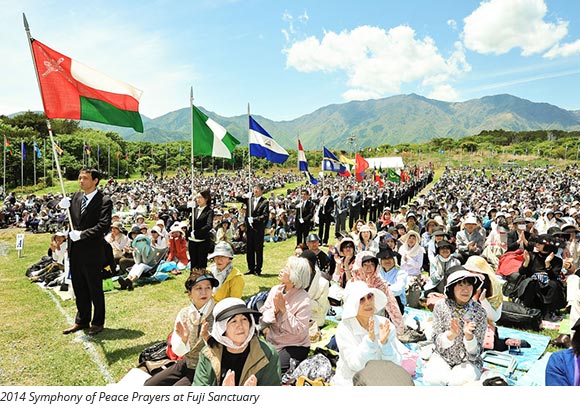
Every year, the SOPP at Fuji is a large-scale event, welcoming many thousands of participants along with an international group of prayer leaders and guests. This year, we are hosting a very special SOPP, in which leaders in many different fields-including politics, business, science, education, and the arts-will join with religious and spiritual leaders from around the world to celebrate the inauguration of the Fuji Declaration.
The Fuji Declaration is an international charter that seeks to awaken the sacred consciousness-the divine spark-in all humanity, in order to spur a transformation in our civilization and create a more peaceful, harmonious way of life on the planet Earth. The declaration has been endorsed by a wide range of prominent individuals around the world who support its ideals and goals.
As a global celebration of harmony and oneness where people from all different backgrounds join together to pray for peace and create a better world, the SOPP at Fuji Sanctuary was seen as the perfect occasion to inaugurate this historic document. Already, the staff of Byakko Shinko Kai are busy preparing and upgrading the grounds of Fuji Sanctuary to get ready for this momentous occasion!
And of course, the 2015 SOPP will include its core programs of ‘Praying with the Religions of the World’ and ‘Prayers for Peace in Each Country and Region’. We are looking forward to conducting these programs with the many new guests and participants who will be experiencing them for the first time. It is our hope that in launching the Fuji Declaration amidst the harmonious, unifying energy of the SOPP, the combined power of these two events will further expand their reach, urging humanity to awaken to its true, divine nature even one day sooner.
The 2015 SOPP ceremony at Fuji Sanctuary is free of charge and open to all. Please contact us if you are interested in attending or need further information. The ceremony will also be broadcast live over the internet, and we invite everyone to tune in. The link for the webcast will be posted here closer to May 17.
Even if you will not be in Japan this May, we hope you will take part in the SOPP by attending or organizing a local ceremony or prayer gathering. The SOPP website has a map with events taking place around the world, and many inspiring resources to help you create your own beautiful peace gathering. If you will be hosting an event or even praying at home on your own, please register on the SOPP website and let us know about it! The more people who take part, the stronger the vibrations of peace and harmony we will send out across the world!
国連本部総会議場での行事の中で行なわれたSOPP 2013年2月14日、アメリカ・ニューヨークの国際連合本部総会議場で、「United for a Culture of Peace Through Interfaith Harmony(宗教間の調和を通じた平和の文化のための結束)」という行事が開催され、第2部の中で「シンフォニー・オブ・ピース・プレヤーズ(SOPP)」が行なわれました。このプログラムでは、11人の宗教代表者が、各宗教宗派の平和の祈りを行ない、その冒頭で、本会西園寺昌美会長が、SOPPの提唱者としてスピーチを行ないました。 国連総会議場で宗教の祈りが行なわれるのは異例のことでしたが、この日、人々は「いかなる宗教信仰があろうとも、平和のもとに一つになれる」ということを謳い上げ、厳かで美しい平和の祈りの交響曲を奏でました。
Wanted to share this important and comical video. The topic of surveillance and corruption is such a critical topic, but I want to share this video because it illustrates something deeper about our culture and society (the whole "dick pic" approach). Its funny and sad at the same time. I'm also deeply intrigued by the power of COMEDY, and the combination of comedy x media x social change. Its important to laugh.
Ok, now back to politics.
Its the frontier of what I'm starting to work on.
Permaculture politics <- does="" like="" look="" p="" this="" what="">What would politically engaged permaculture look like?
Especially in the capitols of countries where money and power are concentrated.
For now, I'll just post something that is quite a big deal with activists in Japan, but probably quite under the radar for most Japanese and English-speakers alike. Its the next generation of a free trade agreement that will most likely prioritize corporate profit rights over human rights. While it may seem unfair and uncomfortable to demonize "corporations", its important to remember that corporations are not people. "A corporation is a company or group of people authorized to act as a single entity (legally a person) and recognized as such in law...Despite not being human beings, corporations, as far as the law is concerned, are legal persons, and have many of the same rights and responsibilities as natural persons do. Corporations can exercise human rights against real individuals and the state" (wikipedia). I'm still trying to understand this dynamic between corporations and human beings, but the problems I see include
1. giant corporations (e.g. Exxon-Mobile, Monsanto, Google) have disproportionately more resources and political power than ordinary people (but both are legal persons).
2. a single corporation's right to potential profit can strike down environmental and labor laws that seek to protect human beings, especially vulnerable populations. Or they demand giant fines from individuals and government.
The proposed agreement began in 2005 as the Trans-Pacific Strategic Partnership Agreement (TPSEP or P4). Participating countries set the goal of wrapping up negotiations in 2012, but contentious issues such as agriculture, intellectual property, and services and investments have caused negotiations to continue into the present,[7] with the last round meeting in Ottawa from 3–12 July 2014.[8][9] Implementation of the TPP is one of the primary goals of the trade agenda of the Obama administration in the United States of America.
On 12 November 2011 the nine Trans-Pacific Partnership countries announced that the TPP intended to "enhance trade and investment among the TPP partner countries, to promote innovation, economic growth and development, and to support the creation and retention of jobs."[10] Some global health professionals, internet freedom activists, environmentalists, organized labor, advocacy groups, and elected officials have criticized and protested the negotiations, in large part because of the proceedings' secrecy, the agreement's expansive scope, and controversial clauses in drafts leaked to the public.[11][12][13][14]
On 16 October 2014, WikiLeaks released a second updated version of the Trans-Pacific Partnership (TPP) Intellectual Property Rights Chapter.[15]
And, there is a piece in there about the internet which I think we all need to be aware and engaged in. Don't take free internet for granted. It might change soon.
The TPP, like Keystone XL (North American tar sands pipeline), is a global game changer. It'll affect you whether you are engaged or not. These affect our global systems, including the ecosystem (our life-support system), economics, and human rights. Learn more for yourself (this post is definitely bias!).
I just made a new page to explain my perspective on economy, gifts, and how my workshops run. Its particularly meaningful to me to do this in Tokyo, the leading financial and consumer capital. Is it possible to thrive on gifts in the heart of the matrix? Let's see!!! Donation and Giftivism
I love giving, and I love receiving. I believe we all do. I’ve been really inspired by the gift economy movement and those who live it. I’ve started to realize that my life thrives on gifts, starting with all that nature provides me (water, air, food, LIFE), and the gifts from my family, farmers, teachers, activists, etc. Without these gifts, I would not exist. I realized I’ve always lived in a gift ecology.
My mission is to create a compassionate world where all life can thrive. A world that cares not just for the 1% or the 99%, but the 100%. I want to live that vision and share that vision. When I moved back to Japan shortly after the nuclear meltdown, I was at a Vipassana meditation retreat thinking about how I would “make a living” doing what i love. I wanted to focus all my energy on social change, through spreading permaculture, mindfulness, nonviolent communication, and creating a revolutionary life-serving social change movement. During my meditation, I created an excel spread sheet in my mind, calculating how many workshops per month, how much I would charge, and how many participants I would need. After a while I reconnected with my breath, it became clear to me, I don’t want to live like that. I’m not here on earth to run a business. I’m here to serve life and I need to find a path that allows me to unleash my fullest potential. The final straw was to learn that the vipassana retreat operates on an pay-it-forward system. You cannot pay for food, lodging, and retreat until you complete the program. Mind blowing. Once you experience vipassana meditation, and you want others to benefit from it, you can pay for the next people, as much as you want. There is also no obligation to pay! In fact, they are making it hard to pay.
That 10-day vipassana meditation retreat in Kyoto was a life changing event in my life. I decided after the retreat that I wanted to live a life based on giving. To experiment with my life and see what happens. Just like the vipassana center, I share my gifts freely. I now believe that if what I do has a meaningful impact, if people believed in it, then I will be supported.
My workshops and my work are not products or services. They are my passion. I want to share and contribute, collaborate and co-create a world rooted in love. I give all that I can because I love it, and if you are inspired to support me in any way, that would be amazing!
For a future filled with inspiration, love, and fun.
Kai the activist 共生革命家
GIFTIVISM INSPIRATIONS (partial list)
Parents, farmers, teachers, activists all over the world!!!
Courses are run solely on a donation basis. There are no charges for the courses, not even to cover the cost of food and accommodation. All expenses are met by donations from those who have completed a course, experienced the benefits of Vipassana, and wish to give others the same opportunity. Neither the Teacher nor the assistant teachers receive remuneration; they and those who organise the courses volunteer their time.
Hello hello
So much going on as usual! Japan and the world is changing rapidly, and I get to be in the exquisite interaction of chaos and harmony.
I have a passion for youth activism, and have kept my antennas out for youth driven movements in Japan, particularly around nuclear power. I offer free training and donation based workshops in hope that I can help enhance their ability to make change. One of my favorites is going on retreat into the only village in Tokyo (up in the mountains), and spend two days doing Nonviolent communication (NVC) workshops, living NVC together, and other fun activities such as building a fire together for the traditional bath. Super fun.
Anyways, some of those friends are working on getting more students involved in activism, and most recently, protesting the secrecy law (aka secret protection law) that has just passed. Their adding a hip hop flare to the protest scene, and making it more fashionable. We'll see how it grows. The media and government are advertising the threat of China, pushing for a bigger military budget, and passing laws that are important for a military agenda. Here we go again.
PS I've been really busy with my Japanese targeted projects so my Living Permaculture blog hasn't been as active. If you want to see what I'm up to, check out Tokyo Urban Permaculture. You might need a human or robotic translator though.