Vision

To help transition Japan to a peace promoting post-carbon country while enjoying every step of the process.
僕のビジョンは、祖国日本で、平和文化を育みポストカーボン(Post-Carbon) 社会を促進してゆく事です。
化石燃料や原子力に頼らず、他国の資源を取らない、
自給自足な国へのトランジションを実現させてゆきたいです。

Sunday, June 27, 2010

Week of 18~22

Here is number 2 posting on the week in review.

Friday: Prepare site for chicken tractor/pen, set up drip system on prunes, weed nursery, collect and organize firewood, weed and thin bamboo grove.

Saturday: Weed nursery, pot up 4 inch pots to 1 gallon, finish weeding and tying up raspberry bushes. There was also a solstice parade in town and a dance party at another farm.

Sunday: Work on new kitchen gray water system.

Monday: Continue on gray water system.

and now for everybody's favorite......

PHOTOS!

Bamboo grove care.

While watching out for new shoots, as they are fragile and pop up in unexpected areas, we weeded and thinned/pruned the bamboo grove (comprised of several varieties). We mulched the grove with the bamboo leaves we pruned off which I believe is high in nitrogen and silica. This area had also been a duck "tractor" site.

Potting up various plants that outgrew their 4 inch pots and needed to upgrade into a gallon pot. We planted a ton of Colutea, a nitrogen fixing flowering deciduous shrub, among other seedlings and clones.
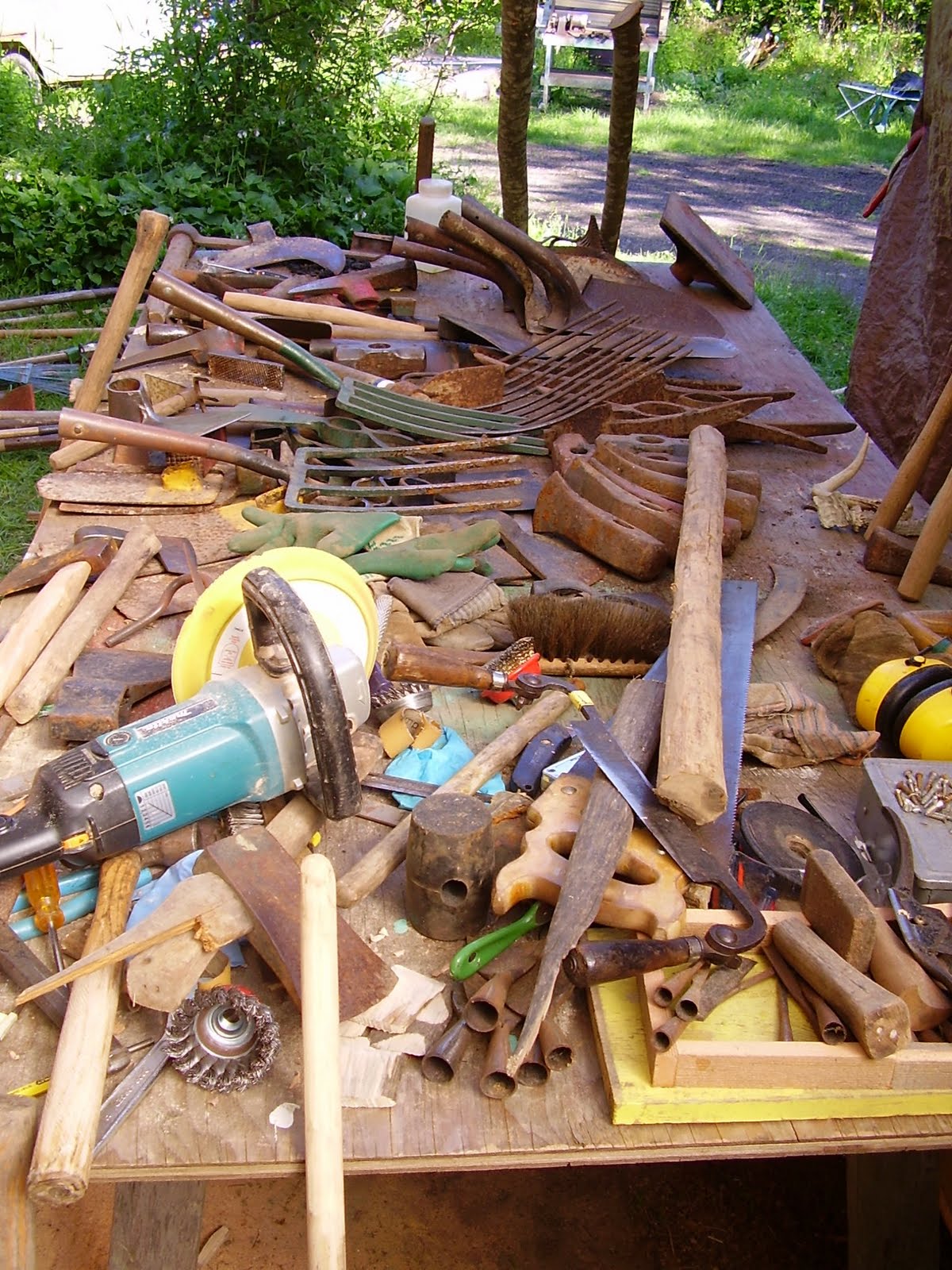
The tool infirmary.....


....waiting for the doctor.

Michael, an old friend of Doug's, who just showed up one day while we were planting squash has a tool fixing business in New Mexico. He just rounded up all the broken or handleless tools and fixes them up while practicing Tuvan throat singing. He also has lots of stories about fixing tools on Native American reservations.

Here he is showing me how to shave wood off of this potential handle so we can fit a tool head on. What a valuable skill to know how to fix/make tools. He makes it sound really easy.


Mims working the kama with style.
We went around the property cutting down comfrey (mulch, dynamic accumulator, grass barrier, medicine, etc) that surrounds the fruit trees to create mulch donuts. Makes the place look so much tidier! The space between the tree and mulch donut is primarily to prevent mice and other creatures from chewing the bark and cambium off, which has killed a few trees on the property.


Trench diggin.
This was the first part of a new gray water system installation for our outdoor kitchen. The trench was to put ABS pipes to move the water to several different mulch pits inbetween fruit trees. I'll post a more detailed explanation of this gray water system.


Michael giving a special presentation on nitrogen fixers and soil ecology. Fascinating. I'll hopefully post up the diagrams and notes from this event. One thing is for sure, he loves nitrogen nodules and fungi.

Leopard Slug

ポピーとこのナメクジの写真は
世界を美しくしてくれる相棒聖子へ。
ヒョウナメクジ

Dedicated to my dear happy love monster.
The Leopard Slug (Limax maximus).


BONUS


EXTRA BONUS
a picture of how the leopard slug mates. Super trippy
上のナメクジの交尾の写真。
とっても不思議です。
http://en.wikipedia.org/wiki/File:Mating_Great_Grey_Slug_4111.jpg

Poppies ぽぴ〜(芥子)

One of the most beautiful things I've ever seen in my life is the poppies that grow here. Breath takingly exquisite.

美。
見るとドキドキしてしまいます。
自然とはなんて美しいものなのだろう。


***
If any of these pictures grab your consciousness, please click on it to see it enlarged into the full size.

もし心が惹かれる写真があれば、その写真をクリックして拡大してください。その方が喜びが増すと思います。

Friday, June 25, 2010

Books and Documentaries

Below is a website I made, and this page is a bunch of my recommended books and documentaries. They have transformed me to who I am today and I think are essential reads. But, I guess we all have our own list of books that we want to share with everyone. In any case, the top 4 were probably the most influential to me and I hope you will come across them someday.

下のホームページはイギリスのブリストルに住んでいたときに始めた物です。リンクは僕の最高のお勧めの本やドキュメンタリーのリストです。時間があれば是非見てみてください。これらによって僕の人生が大きく変わりました。特に上位4冊の本。かなり世の中を観察して理解する視力が深まりました。世界には賢い人がいっぱいいますね〜。関心。

http://sustainabilian.web.fc2.com/booksfilms.html

Wednesday, June 23, 2010

Week of July 11-14

I think I'm going to start documenting our group activities for the week. Something that I got into through when I was trained as a co-organizer for the Education for Sustainable Living Program at UC Santa Cruz. We used documentation as a method of institutional memory, and effective coordination and organizational growth. Anyways, I think it is a valuable skill to document and a potentially useful tool for next year, and maybe other people are wondering how our weeks are going.

一週間の流れをもっと具体的に記録する事にしました。

Fri: Hole digging for OH, consolidating wood piles, planting the rest of the winter squash in the FFF and labeling them, adding panels to the solar array, tool making (e.g. handles)
金曜日:アウトハウス用の穴堀、木材の整理、残りのカボチャ植えと種類のラベル付け、ソーラーパネルの整備、道具作り(シャベル用のハンドルなど)。

Sat: Weeding and maintenance in the FF nursery, planting oca (oxalis tuberosa: a root vegetable from the Andes) between grafted tree rows, topworking (grafting), tool making continued. Afternoon gardening time.
土曜日:ナーサリー(苗木場)の草抜きと整備、接木の間にオカ植え(オカはアンデス山脈からきた根菜)、トップワーク(接木)、道具作りの続き。

Sun: Cleaning! Finish inspecting and activating remaining drip systems for non-garden areas (e.g. I am responsible for the chestnut orchard planted during the design course last year).
Pictured: The hilling of potatoes.
日曜日:掃除!あらゆる散水システムの点検と作動(例えば、僕は去年のデザインコースで植えられた栗園を散水するドリップシステムを担当しています。

Mon: Finish up projects and work on the gray water system from kitchen sink.
Then we cleaned up the gooseberry area near Doug's. We began to prematurely harvest the berries because they were infected with some kind of maggot.
In Hawaii thats called a "real bumma!"
The interns & guests decided to use these premature gooseberries and make gooseberry worm pie. mmmmm...
月曜日:終わらなかったプロジェクトを完了させながら、グレイーウォター(トイレ以外の排水)システムを作り始めました(穴堀)。午後は、ダグの家の近くのグースベリー畑の整備をしました。ベリーに幼虫がいる事が発覚したので、大きくなる前に収穫をし始めました。ほぼ全部のグースベリーが幼虫に住み込まれていた現実にダグが凄く残念そうな表情をしていました。もったいなかったので、研修生で未成熟グースベリー(幼虫入り)パイを作って味わいました。

PICTURES

The lush potatoes ready to be hilled one last time.
ぐんぐん育つお芋さん達。

ゲスト4人に研修生のみんなで芋の土寄せ。
手前の植物はニンニク。
Hilling work party with two guests and the intern crew.
A glorious moment where everybody is engaged with the task at hand.

Close up of hilled potatoes.
土寄せされたお芋さん達。
もともとは溝の中に植えました。

日曜日のポットラック。
晴れていたからだろうか、ゲストが六人ぐらい参加しました。
Sunday potluck.
A nice sunny day with a bunch of guest to share the feast with, yeah!

お寿司(右の小皿は特別納豆寿司)に、メロンのシャンツァイ、ヤギのハードチーズサラダ、野生酵母のこねなくて良いライ麦パンにプラムとイチゴのジャム、ポレンタにレンズカレーが載せられたもの、サツマイモとセージのローストなど。食べ物マニアの持ちよりパーティー。

We had a variety of futomaki sushi (salmon, natto, avocado, egg, veggies, etc), hard goat cheese for salad topping, no knead wild yeast rye bread with plum and strawberry jam, yams roasted with sage, melons covered with cilantro, etc. Yeah!


Farm girls chillen between gray water system hole diggin.
I like the wheel barrel dirt chair, that's classy.
若い農女達。
土いっぱいの台車を椅子代わりにしてる所がかっこ良い!
ここのみんなは二十代前半の子で、せっせと1立法メートルぐらいの穴をいくつか掘っていました。


Gooseberry bushes getting cleaned up. Mainly weeding.
グースベリー畑の草抜き。

The horror, the horror.
Does anybody know what maggot this is?
By the way, the pie turned out great:)
グースベリーの中で生まれた幼虫。
何の虫なんでしょうか?

夜のガーデン

今は月の明かりの下で、
ギターの歌を聴きながら、
ケートレンが畝の周りの草をかまで刈ってる。
僕はなぜか、こんな自然の中でマックにブログエントリーを打ち込んでいる。
何か変な感じもするが、
そういう生活を選んだからには楽しむしかない。
因に現在夜10時過ぎ。
ギターはノリノリで響きながら、暗闇から鎌がしゃっしゃっしゃと音を放つ。
とても良い日だった。

目を覚まして最初に気付いたのは霧が張っていた事。
珍しいので眺めていたら、そっと太陽が霧の向こうから顔を出した。
その瞬間確信したのが、
今日は洗濯の日である事。
なぜか絶対晴れると感じた。
図星。

洗濯物を干してから、紅茶を準備して森をバックにビデオスカイプをした。
どうせビデオスカイプをするのならば、
相手が自然の中で映っている方が見心地が良いと思う。
スカイプの後は菜っ葉とラディッシュの間引き収穫をした。
間引きってめっちゃめんどくさいと思いながら、
せっせと雑草も抜きながら、ラディッシュの間引きに取り組んだ。
その時楽しみだったのは、間引きをした野菜でキムチを始めて作る事やってん。
取り立て菜っ葉とラディッシュに生姜を擦り込んだキムチ。
今すぐにでも食べたい。

昼食はサラダ2杯にケートレンが焼いたナツメとヘーゼルナッツマフィン。満腹ながらもピーチパイらしきものも焼かれていたので、ヨーグルトを載せてベリーソースもかけて食べた。

午後は人参の間引きをして、めちゃめちゃ暑くなったから裸で池に飛び込んだ。
リフレッシュ。
池の周りは1メートルまで伸びた種を育んでいる草が壁の様に囲んでいた。
せっかくだから、今年始めてのクロールをかました。
二周してすっきりしてから、裸の間引きを続けた。
自然乾燥してから間もなく寒くなって来たので、
ようやく服を着る事にした。
耳が日焼けしてしまった:(

そんな様な流れで今は畝の間で音楽を聴きながらブログを書いている。
文句なし。

Tuesday, June 22, 2010

Ginko Nut

Daver brought some Ginko nuts from the Japanese market on the mainland, so I roasted them up. The last time I was in Japan during the winter, my mom roasted some ginko nuts and I was amazed at how chewy and tasty they were.

I don't think a single intern had ate a ginko nut roasted before, and probably for most it was they first ginko nut that set foot into their mouths. Our question was what is the nutritional content of ginko nut? I'll do some research and update this but if you know any good sources leave me a comment por favor.

Here is info from a company that is selling in bulk (minimum order 1 ton),
"Ginkgo seed contains many nutritional ingredients such as amylum, protein, fatty acid; it also contains mineral substances such as vitamin C, lactochrome, phosphor, iron, kalium, and magnesium."
I wonder if I can find something more specific than that.

UPDATE
Here is more info
http://www.nutritiondata.com/facts/nut-and-seed-products/3119/2
According to this website, that references USDA SR-21 for their data, the caloric breakdown of a raw ginkgo nut is:
84% Carbs
8% Fats
8% Protein

UPDATE 2
"....amino acid ginkgolin has been found by researchers to be concentrated in both the nuts and leaves of the plant. ginkgolin has been clinically shown to increase the blood flow to the brain and improve the memory." -New England Ecological Garden
http://www.unh.edu/neeg/ginkgo.html

Monday, June 21, 2010

Life unto Death


On our way to the contra dance.
コントラダンスへ歩いていると時の景色。


Saturday, June 19, 2010

update announcement

I added 3 pix to the Super Hero Party entry

Abundance and "Just Enough"

I started writing this after the last natural farming article I wrote. The previous "just enough" article was inspired by this entry.

Abundance and "Just Enough"

Here on the homestead (and in other permaculture circles I've been a part of), abundance seems to be a major goal that we are working toward. More food, more diversity, more biological material, etc. There seems to be nothing inherently wrong with that, in fact its awesome. But, I've been struggling with this approach since I also associate it to the mentality of modern industrial and consumer culture: More and more stuff. More stuff usually means more waste, and we do that as a regular practice in modern life. And sometimes it is not so much the apparent element (like water) we are wasting, but the energy that is associated to that resource. I like what I read in the Humanure Handbook, something like "there is no waste in nature, only human nature."

Abundance often means we don't need to be as conscious of how we use things. Particularly if we have no feedback loop to keep us in check. If we have a faucet with endless water, we can let it go into the drain without ever using most of it, or even being aware of it. Think about how most modern dwellers wash dishes, take showers, brush teeth, urinate in a toilet full of fresh water, etc. Including myself. In Costa Rica when we were carrying our water over a small hill, we would use it preciously. For example, we wash the corn nesquesado (a preparation to make tortillas) and collect that water to wash our dishes with it, then collect it and water specific plants. 3 uses out of a small amount of water. We were able to do this because we had a strong intention to put our values into practice and because we had to carry this water, and water is heavy stuff. We had an effective feedback loop in the form of physical energy exerted. I think the danger largely lies when the feedback loop is not working. I've been a lot more conscious around my use and misuse of food, water, and energy. But, there are definitely certain behaviors/habits that are hard to transform.

I believe scarcity and limits help us to be more conscious of our consumption and use. It helps us moderate our consumption habits and look deeper into the relationship of what we need and what we want in the short-term. Growing up in Japan, and spending time in rural Costa Rica, Nicaragua, and Cuba in addition to what I learned about wartime and postwar Japan really helped me understand the effects (positive and challenging) of scarcity and limits. Reading Donella Meadows further reinforced my understanding of this phenomena from a systems-thinking point of view. If you've never read "Places to Intervene in a System" I highly recommend this short piece.
http://www.developerdotstar.com/mag/articles/places_intervene_system.html
*Especially for people who want to make social change and make this world a better place.
Meadows is also the author of "Limits to Growth" and "Systems Thinking: A Primer" that I am reading.

I remember a documentary I watched in a psychology class where a lottery winner destroyed his life after he received the winnings. He was probably working or middle class, then became a millionaire, and after a year he was homeless. I think about the many aid projects in developing countries or devastated areas spending hug sums of money on inappropriate foods/infrastructure/technologies that don't benefit the intended population. Or when people indulge in foods that are good for them only in moderation or maybe not even good for them at all. My weakness is for freshly baked bread, especially croissants and sour dough bread. Oh and Mont Blanc (sweet chestnut cream) cake. If there is a bunch of these, I will always eat more. I have a very hard time moderating my consumption of these foods among many others. But, perhaps the most pungent experience of over-consumption facilitated by abundance is that of energy and products produced from fossil fuels. Transportation, heating, food production, plastic, war, etc.

I guess this thought has gone long enough for today, but I think I need to both appreciate the experience of abundance while looking critically at how we interact with it. Maybe balance, as natural farmers teach, is what we should be aiming for.

Living in a way to appreciate and be creative with limits and scarcity.